


增加能源成本没有耗尽你的budget. Having an appropriate cleanroom design and selecting practical equipment can control energy-related expenses. Below are seven cost-efficient tactics to help you maintain your cleanroom performance and productivity without breaking your budget.
1) How big should your cleanroom be?
Let’s start with the decision of modular versus bricks-and-mortar. With a modular room, building permits are usually not required, and if your business moves to a different location, modular rooms can be disassembled and re-built in the new space.You should also consider the size of your cleanroom. Design the floor plan and height of the ceiling to meet your specific needs. Keep in mind the future you visualize for your controlled environment. Initially larger spaces are more expensive to construct and maintain, but if your facility plans on future expansion, a bigger cleanroom means you’re ready for operation when workflow increases: no waiting for additional components to arrive and be installed.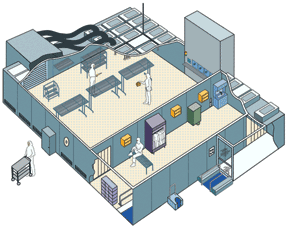
2) Do you have the right air conditioner?
Having the wrong air conditioning unit not only jeopardizes the integrity of your controlled space, but it also creates unnecessary costs.
Depending on the application, room and equipment size/type, and the quantity of personnel, your pre-existing HVAC (high-volume air conditioning) system might be the most economical option for cooling down your cleanroom. However, the cleanroom will impose additional thermal demands on the HVAC system, so you must ensure that it can handle the total energy load. In addition, some critical applications may require a dedicated system to ensure cleanroom temperature uniformity if the central system goes down.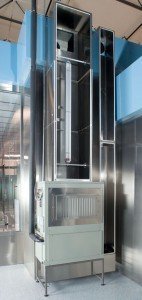
While a dedicated AC module offers a possible solution to an overworked HVAC unit, or to a building without an air conditioning system, it is not always the best answer. The AC module dumps heat generated by the compressor to the area surrounding your cleanroom. The result: an increased burden on your facility’s existing HVAC and the AC module as each system must work harder to lower the temperature of the ambient air. In order to operate in the most efficient manner, ventilation fans and exhaust ducts should be installed to redirect and release air outdoors—both of which cost money.
对于较大的模块化洁净室,分体式辅助中央空气系统可能是最佳选择。发热压缩机在设施外部移动,降低内部热量。在到达风扇/过滤器单元(FFU)之前,再循环系统和管道控制并将充足量的排气空气路由到AC系统,确保加热的空气未释放到周围设施中。
3) How can a pass-through chamber save money?
通过节省时间和金钱,战略性地放置或谈话。将较少的人员才能转移材料或用品。Gowning流程需要供应,并且可能是耗时的。
Although access doors are an effective way for employees to enter or exit a critical space, they present opportunities for pressure differential fluctuations between zones. The relatively small air volume of a pass-through chamber eliminates this issue, efficiently maintaining stable pressure and reducing contamination from added foot-traffic. Energy costs are contained by reducing pressure recovery times.
4) What type of fan/filter unit makes sense?
更换FFU过滤器,包括清洁,测试,认证和将受控环境恢复到正确的ISO级别,这些成本与其相关联。每小时的停机时间等于收入损失。使用房间侧更换(RSR)风扇/过滤器单元,防止污染,因为过滤器可以在洁净室内更换而无需违反天花板屏障。RSR在替换过程中消除了需要长时间停机的需求。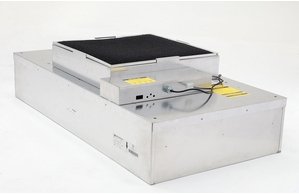
欧洲联盟的ERP 2015指令和加利福尼亚州的标题24为低能源使用和相关的能源成本设定了更高的标准。为了解决这一问题,特别是在符合低能量使用规定的设施中,通常需要具有高效DC电动机的电换向(EC)风扇/过滤器单元。虽然这些单位通常具有更高的购买价格,但它们在较低的能源使用和电力账单方面迅速支付自己。
5) Would using a pre-filter help?
Absolutely! Pre-filters are less expensive than HEPA or ULPA filters and can be cleaned and reused. Certain pre-filters have been rated up to 80% efficient at removing linty dusts from airflow, decreasing the particle impact on your more FFU filter. Fewer particles mean a longer lasting HEPA and/or ULPA filter.
6)什么是经济的照明选项?
节能LED(发光二极管)面板产生较少的热量,降低冷却成本。腔输出类似于荧光灯,但灯泡持续5至8倍。对于具有全额或近总FFU覆盖的客房,LED条带直接粘附在FFU之间的天花板网格上,确保层流不受阻碍。
7) How is an EnergySaver system beneficial?
EnergySaver FFU control systems are paired with a power distribution module (PDM) to provide an easy approach for adjusting fan speeds. Climbing on a ladder to adjust individual FFU speed is no longer necessary! The EnergySaver eliminates ceiling breaches, allowing per-zone remote fine-tuning of flow volume, air change rate, and internal pressure. Night setback mode preserves the integrity of your cleanroom at a lower fan speed when the room is unoccupied—less heat is emitted and energy is saved.
To save, you first must invest; while some of these advanced features may initially cost more money, their energy-efficiency and low-maintenance requirements save substantially on a long-term basis.